Phenomena · Space Codex
Wormhole
General relativity allows tunnels linking distant regions of spacetime, but none has ever been observed.
A hypothetical shortcut through spacetime
At a glance
Key points
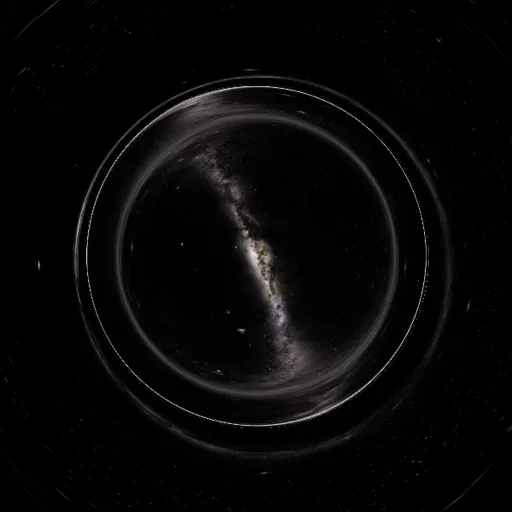
A traversable wormhole would have no event horizon: its mouth would look like a crystal ball showing the sky on the far side.
- No event horizon: a traversable wormhole lets you come back
- Its mouth would show the destination sky like a crystal ball
- Would need negative-energy 'exotic' matter
What it would look like
Seen from outside, the mouth is a sphere with the other universe's sky painted on it, distorted by lensing, and wrapped in a bright Einstein ring of the stars behind you. There is no dark shadow and no accretion disc, both black-hole features. Crossing the throat, the destination sky would swell to fill your view.
The catch
Keeping a throat open requires material with negative energy density. The Casimir effect shows small amounts exist, but quantum limits restrict how much and for how long. Kip Thorne designed the 1988 model partly as a teaching tool for general relativity.
What we still don't know
Whether quantum gravity permits macroscopic traversable wormholes at all. Theoretical work on entanglement and spacetime, sometimes summarised as ER = EPR, links the idea to quantum physics, but not to anything a ship could fly through.
First-hand · our 3D model
How we render it
The wormhole destination uses exact lensing for an Ellis wormhole, the simplest traversable wormhole solution in general relativity. Ray deflection is computed in closed form with Carlson elliptic integrals, and our tests check that closed form against direct numerical integration. The mouth behaves like a crystal ball: it shows a different sky through the throat, ringed by an Einstein ring where light from behind the mouth is bent around it.
The sky seen through the mouth is illustrative, our own galaxy viewed towards its centre, because no one knows what lies on the far side of a hypothetical wormhole. The transit that plays between destinations is a separate full-screen shader: it combines relativistic aberration, the same Ellis lensing and Doppler colour shifts at up to 86% of the speed of light. It is a visual device, not a claim about real spaceflight, and under reduced motion it becomes a single still frame.
Related entries
- Black holeEvent horizon · gravity light cannot escape
- What is a wormhole?A hypothetical tunnel through spacetime
- Gravitational wavesRipples in spacetime
Sources
- Ellis 1973, J. Math. Phys. 14:104 (opens in a new tab)
- Morris & Thorne 1988, Am. J. Phys. 56:395 (opens in a new tab)
- Fuller & Wheeler 1962, Phys. Rev. 128:919 (opens in a new tab)
- James, von Tunzelmann, Franklin & Thorne 2015, CQG 32:065001 (arXiv) (opens in a new tab)
- Caltech: wormhole dynamics on a quantum computer (opens in a new tab)
Last reviewed against these sources. Built from public NASA, ESA and JPL data; not affiliated with or endorsed by any agency.