Sun & planets · Space Codex
The Sun
An ordinary yellow-white dwarf star holding 99.8% of the Solar System's mass.
G2V main-sequence star · 4.6 billion years old
At a glance
Key points
Its 5,772 K surface, magnetic cycle and outflowing wind set the conditions on every planet.
- About 1.3 million Earths would fit inside it
- The corona is around 2 million °C, far hotter than the surface
- Cycle 25 peaked in October 2024, beating its forecast by about 40%
Interior
Fusion happens only in the core, the inner fifth of the radius, where hydrogen burns to helium at 15.7 million K. Energy then diffuses outward through the radiative zone, a random walk that takes on the order of 170,000 years, before rising convection cells carry it the last 30% of the way. Once it leaves the photosphere, the light reaches Earth in 8.3 minutes.
Surface and atmosphere
The visible photosphere is only about 400 km thick and is tiled with granules, each a convection cell roughly the size of a country. Above it the temperature falls, then climbs steeply through the chromosphere and transition region into a corona at one to two million degrees: hundreds of times hotter than the surface below.
The magnetic cycle
Every eleven years or so the Sun's magnetic field flips. Cycle 25 peaked in October 2024 at a smoothed sunspot number of 160.9, about 40% above the official forecast of 115, and activity is now declining. Solar Orbiter caught the south pole with mixed polarity at maximum, the field caught mid-flip.
Exploration
Parker Solar Probe now skims 6.1 million km above the surface at 692,000 km/h, the fastest any human-made object has travelled. Solar Orbiter returned the first images of the Sun's poles in 2025 and will tilt its orbit further after a Venus flyby on 24 December 2026.
What we still don't know
Why the corona is so much hotter than the surface, how the solar wind is accelerated to hundreds of kilometres per second, and how to forecast the strength of the next cycle years ahead.
Missions
- 2018–
Closest pass 24 Dec 2024 (6.1 million km); extended into 2029.
- 2020–
Solar Orbiter
ESA / NASAActiveFirst images of the Sun's poles (2025); Venus flyby 24 Dec 2026 raises its view to 24° latitude.
- 1977–
Jupiter 1979, Saturn 1980; interstellar space since 25 Aug 2012.
First-hand · our 3D model
How we render it
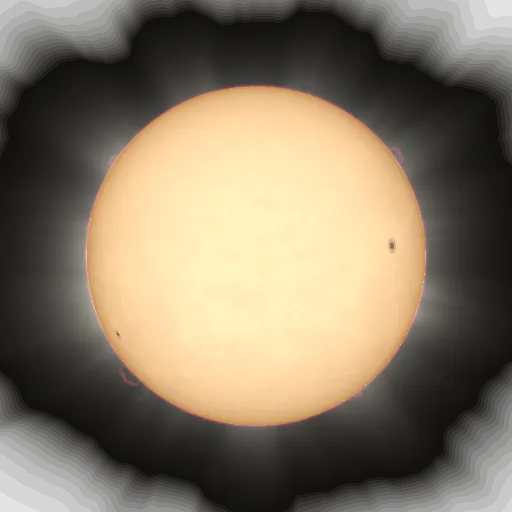
The Sun is an emissive shader, not a lit sphere. A colour map supplies large-scale mottling, and animated 3D Worley noise draws granulation: bright convection cells split by dark lanes (lighter devices get a cheaper value-noise version). Limb darkening is computed per colour channel and is strongest in blue, so the edge reddens as well as dims. A few illustrative sunspots carry an umbra and penumbra, and faculae appear only near the limb, where they show against the darker disc.
Around the disc, a camera-facing layer draws a K-corona falloff, low-frequency helmet streamers that favour the equator, a thin hydrogen-alpha chromosphere with spicules, and a few prominence arches. The warm colour is an artistic grade: the real photosphere is close to white. When post-processing is on, the photosphere and corona are lifted into HDR so that only they cross the bloom threshold.
Sizes and distances in the model are not to scale, so every world can be seen up close. Colour maps are derived from NASA mission imagery via Solar System Scope (CC BY 4.0). The first frame uses light startup maps; higher-resolution maps stream in after the scene is on screen, decoded off the main thread so the page stays responsive.
Related entries
- The heliosphereThe bubble blown by the solar wind
- Parker Solar ProbeThe fastest human-made object
- Voyager 1First spacecraft in interstellar space
Sources
- NASA NSSDC Sun Fact Sheet (opens in a new tab)
- NASA Science: Sun facts (opens in a new tab)
- NASA NSSDC Planetary Fact Sheet (opens in a new tab)
- NOAA SWPC observed solar-cycle indices (opens in a new tab)
- NASA Science: Voyager interstellar mission (opens in a new tab)
Last reviewed against these sources. Built from public NASA, ESA and JPL data; not affiliated with or endorsed by any agency.