Sun & planets · Space Codex

Saturn

The only planet less dense than water, wrapped in rings that span 282,000 km yet are typically about 10 m thick.

Ringed gas giant
  • Last reviewed 10 Oct 2026
  • 5 sources
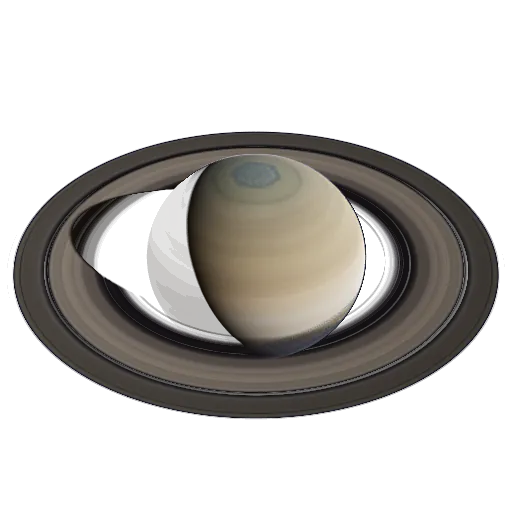
Saturn as drawn by our real-time 3D model
Still rendered from our real-time 3D model. Surface colour from NASA imagery via Solar System Scope (CC BY 4.0).

At a glance

Saturn at a glance, with sources
MeasureValueSource
Mean radius58,232 km (9.1 Earth)JPL Solar System Dynamics: planetary physical parameters (opens in a new tab)JPL Solar System Dynamics: planetary physical parameters (opens in a new tab)
Equatorial radius60,268 kmJPL Solar System Dynamics: planetary physical parameters (opens in a new tab)JPL Solar System Dynamics: planetary physical parameters (opens in a new tab)
Mass5.683 × 10²⁶ kg (95.2 Earth)JPL Solar System Dynamics: planetary physical parameters (opens in a new tab)JPL Solar System Dynamics: planetary physical parameters (opens in a new tab)
Mean density0.687 g/cm³ (less than water)JPL Solar System Dynamics: planetary physical parameters (opens in a new tab)JPL Solar System Dynamics: planetary physical parameters (opens in a new tab)
Equatorial gravity10.44 m/s²JPL Solar System Dynamics: planetary physical parameters (opens in a new tab)JPL Solar System Dynamics: planetary physical parameters (opens in a new tab)
Escape velocity36.09 km/sJPL Solar System Dynamics: planetary physical parameters (opens in a new tab)JPL Solar System Dynamics: planetary physical parameters (opens in a new tab)
Rotation10.66 hoursJPL Solar System Dynamics: planetary physical parameters (opens in a new tab)JPL Solar System Dynamics: planetary physical parameters (opens in a new tab)
Year29.46 Earth yearsJPL Solar System Dynamics: planetary physical parameters (opens in a new tab)JPL Solar System Dynamics: planetary physical parameters (opens in a new tab)
Mean distance from Sun9.54 AU (1.43 billion km)NASA NSSDC Planetary Fact Sheet (opens in a new tab)NASA NSSDC Planetary Fact Sheet (opens in a new tab)
Sunlight travel time1 h 19 minNASA NSSDC Planetary Fact Sheet (opens in a new tab)NASA NSSDC Planetary Fact Sheet (opens in a new tab)
Axial tilt26.73°NASA NSSDC Saturn Fact Sheet (opens in a new tab)NASA NSSDC Saturn Fact Sheet (opens in a new tab)
Temperature at 1 bar−139 °C (134 K)NASA NSSDC Saturn Fact Sheet (opens in a new tab)NASA NSSDC Saturn Fact Sheet (opens in a new tab)
AtmosphereH₂ 96.3%, He 3.25%NASA NSSDC Saturn Fact Sheet (opens in a new tab)NASA NSSDC Saturn Fact Sheet (opens in a new tab)
Equatorial windsUp to about 500 m/sNASA Science: Saturn facts (opens in a new tab)NASA Science: Saturn facts (opens in a new tab)
Magnetic field578 times as powerful as Earth'sNASA Science: Saturn facts (opens in a new tab)NASA Science: Saturn facts (opens in a new tab)
Moons293 confirmedas of Aug 2026NASA Science: Saturn moons (opens in a new tab)NASA Science: Saturn moons (opens in a new tab)
RingsMain A, B, C plus D, E, F, G; out to 282,000 kmNASA Science: Saturn facts (opens in a new tab)NASA Science: Saturn facts (opens in a new tab)
Cassini Division4,700 km wideNASA Science: Saturn facts (opens in a new tab)NASA Science: Saturn facts (opens in a new tab)

Key points

Its moons include Titan, with a thick atmosphere, and Enceladus, which sprays its ocean into space.

  • The only planet less dense than water
  • 293 known moons, more than all other planets combined
  • A hexagonal jet stream wider than two Earths circles its north pole

Interior

A dense core of rock and metal sits under layers of liquid metallic hydrogen and then liquid molecular hydrogen. Saturn radiates more heat than it receives from the Sun, partly because helium rain slowly sinks through the interior.

Rings

The rings are billions of water-ice fragments, from dust to house-sized blocks. They span 282,000 km but are typically only about 10 m thick. The Cassini Division, a 4,700 km gap between the A and B rings, is swept clear by a resonance with the moon Mimas.

Atmosphere and weather

Equatorial winds reach about 500 m/s. A six-sided jet stream about 30,000 km across circles the north pole, and in September 2026 a study of Hubble images reported a ten-sided wave around the south pole.

Exploration

Pioneer 11 and both Voyagers flew past; Cassini orbited from 2004 to 2017 and dropped the Huygens probe onto Titan in 2005. NASA's Dragonfly rotorcraft is due to launch no earlier than July 2028 for Titan.

What we still don't know

How old the rings are, how long Saturn's day is at depth, and how the polar hexagon has stayed stable for decades.

Moons

The 7 major moons of Saturn in the Codex, each with its own sourced entry.

  • MimasThe 'Death Star' moon with a hidden ocean
  • EnceladusThe moon that sprays its ocean into space
  • TethysIce moon split by a giant canyon
  • DioneCratered moon laced with ice cliffs
  • RheaSaturn's second-largest moon
  • TitanA moon with weather, rivers and seas
  • IapetusThe two-faced moon

Missions

  1. 1973–1995

    Pioneer 11

    NASACompleted

    First Saturn flyby (1979).

  2. 1977–

    Voyager 1

    NASAActive

    Jupiter 1979, Saturn 1980; interstellar space since 25 Aug 2012.

    Mission page (opens in a new tab)

  3. 1977–

    Voyager 2

    NASAActive

    The only spacecraft to visit Uranus (1986) and Neptune (1989); interstellar since 5 Nov 2018.

    Mission page (opens in a new tab)

  4. 1997–2017

    Cassini–Huygens

    NASA / ESA / ASICompleted

    Orbited Saturn 2004–2017 and ended by diving into the planet.

  5. 14 Jan 2005

    Huygens probe

    ESACompleted

    Landed on Titan: the most distant landing ever made.

  6. Launch NET Jul 2028

    Dragonfly

    NASAPlanned

    Nuclear-powered rotorcraft; arrives at Titan around 2034 for a 3.3-year mission.

    Mission page (opens in a new tab)

First-hand · our 3D model

How we render it

Saturn's rings span 1.12 to 2.27 Saturn radii, the NSSDC values. They are shaded as a single-scattering slab rather than a flat picture: the dense B ring darkens when you see its unlit face, while the dusty C ring and the Cassini Division brighten when backlit. The globe casts its shadow across the rings, and the rings cast theirs onto the globe.

The globe itself is the flattest in the Solar System, with a polar radius 0.902 of the equatorial, and is tilted 26.7°. A faint hint of the north-polar hexagon, the standing jet-stream wave near 78°N, turns with the planet. Seven major moons orbit outside the rings.

Sizes and distances in the model are not to scale, so every world can be seen up close. Colour maps are derived from NASA mission imagery via Solar System Scope (CC BY 4.0). The first frame uses light startup maps; higher-resolution maps stream in after the scene is on screen, decoded off the main thread so the page stays responsive.

  • TitanA moon with weather, rivers and seas
  • EnceladusThe moon that sprays its ocean into space
  • DragonflyA rotorcraft for Titan

Sources

  1. JPL Solar System Dynamics: planetary physical parameters (opens in a new tab)
  2. NASA NSSDC Planetary Fact Sheet (opens in a new tab)
  3. NASA NSSDC Saturn Fact Sheet (opens in a new tab)
  4. NASA Science: Saturn facts (opens in a new tab)
  5. NASA Science: Saturn moons (opens in a new tab)

Last reviewed against these sources. Built from public NASA, ESA and JPL data; not affiliated with or endorsed by any agency.