Exoplanets · Space Codex
Proxima Centauri b
A planet at least as massive as Earth orbiting the closest star to the Sun, inside its habitable zone.
The nearest exoplanet · 4.24 light-years
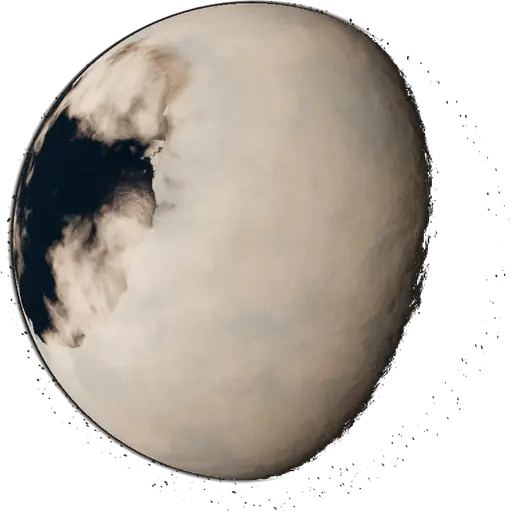
Artist's concept. No telescope has seen Proxima Centauri b as more than a point of light, and most exoplanets not even that. What we know comes from how a planet dims or tugs its star. Any picture of its surface, colour or sky, anywhere, is an illustration, not an observation.
At a glance
Key points
It does not transit, so its size and atmosphere are unknown.
- Orbits the nearest star to the Sun
- In its star's habitable zone
- Size and atmosphere unknown
What we know
Only its minimum mass and its 11-day orbit. It probably rotates in step with its orbit, or perhaps three times every two orbits, and receives about two-thirds of the sunlight Earth does.
How it was found
In early 2016 ESO's 'Pale Red Dot' campaign watched Proxima almost nightly with the HARPS spectrograph at La Silla, sharing progress publicly as it went. Combined with older data, the spectra showed the star creeping towards and away from us every 11.2 days. The August 2016 Nature paper gave a minimum mass of about 1.3 Earths; later measurements with ESPRESSO and NIRPS refined that to about 1.06.
A triple-star neighbourhood
Proxima is gravitationally bound to Alpha Centauri A and B, circling them about once every 550,000 years and now roughly 13,000 AU away. From the planet, that Sun-like pair would appear as a single, very bright star.
The flare problem
Proxima flares frequently and strongly. Repeated bursts of X-rays and ultraviolet could strip away an atmosphere over billions of years.
What we still don't know
Whether it has any atmosphere at all. Because it never transits, JWST cannot take its transmission spectrum; future extremely large telescopes may detect its reflected light directly.
About this view
Artist's concept, one of two equally valid looks: an 'eyeball' world with open ocean under a fixed red sun and ice everywhere else (the other is bare dark rock). The lighting and the star's size in the sky, about three times the Sun's from Earth, follow from its 2,900 K temperature and 0.0485 AU orbit.
Missions
- 2021–
Infrared observatory at Sun–Earth L2, about 1.5 million km from Earth.
First-hand · our 3D model
How we render it
Proxima b is drawn as an "eyeball" world: an ice shell with open ocean within 34° of the point that always faces the star, a convective cloud deck over that ocean, and a tight sunglint on open water. It is one of two looks the data allow equally; the other is bare dark rock. Its 2,900 K red dwarf appears about three times as wide as the Sun does from Earth and is drawn heavily spotted.
No telescope has imaged the surface of any planet shown here, so what you see is an artist's concept: the surface is generated by a shader from noise, not drawn from a map, and its colours and features are illustrative. What is tied to measurement is the starlight and the geometry. The host star's colour is a blackbody at its catalogued temperature, and the planet is tidally locked, with a fixed day side facing the star and a permanent night side.
The host star hangs in the sky at its true apparent size seen from the planet (its radius divided by the orbit), with limb darkening that is stronger in blue and animated granulation. The planet is lit only from that star's direction and in its colour, adapted 40% towards white the way an eye adapts to a single light source. A surface glows only where it is hot enough to glow in visible light, judged from Planck's law at 550 nm. Where the concept has an atmosphere, a ray-marched haze shell adds the limb glow (10 samples at full quality, 6 at reduced, none at minimal).
Related entries
- Exoplanets: the censusPlanets around other stars
- TRAPPIST-1Seven Earth-sized worlds · about 40.5 light-years
Sources
- Anglada-Escudé et al. 2016, Nature 536:437 (arXiv) (opens in a new tab)
- ESO: The Pale Red Dot campaign (ann16002) (opens in a new tab)
- Kervella et al. 2017, A&A 598:L7 (arXiv) (opens in a new tab)
- NASA Exoplanet Archive: Proxima Cen overview (opens in a new tab)
Last reviewed against these sources. Built from public NASA, ESA and JPL data; not affiliated with or endorsed by any agency.