Sun & planets · Space Codex

Neptune

The outermost planet, predicted from Uranus's wobbles before anyone saw it.

Windiest world · found by mathematics
  • Last reviewed 10 Oct 2026
  • 5 sources
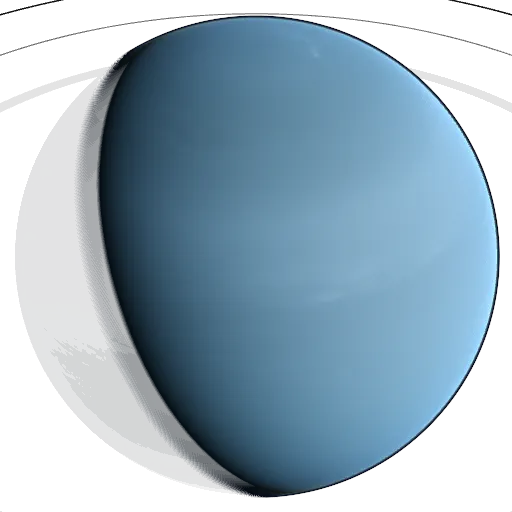
Neptune as drawn by our real-time 3D model
Still rendered from our real-time 3D model. Surface colour from NASA imagery via Solar System Scope (CC BY 4.0).

At a glance

Neptune at a glance, with sources
MeasureValueSource
Mean radius24,622 km (3.9 Earth)JPL Solar System Dynamics: planetary physical parameters (opens in a new tab)JPL Solar System Dynamics: planetary physical parameters (opens in a new tab)
Mass1.024 × 10²⁶ kg (17.1 Earth)JPL Solar System Dynamics: planetary physical parameters (opens in a new tab)JPL Solar System Dynamics: planetary physical parameters (opens in a new tab)
Mean density1.64 g/cm³ (densest giant planet)JPL Solar System Dynamics: planetary physical parameters (opens in a new tab)JPL Solar System Dynamics: planetary physical parameters (opens in a new tab)
Equatorial gravity11.15 m/s²JPL Solar System Dynamics: planetary physical parameters (opens in a new tab)JPL Solar System Dynamics: planetary physical parameters (opens in a new tab)
Escape velocity23.56 km/sJPL Solar System Dynamics: planetary physical parameters (opens in a new tab)JPL Solar System Dynamics: planetary physical parameters (opens in a new tab)
Rotation16.11 hoursJPL Solar System Dynamics: planetary physical parameters (opens in a new tab)JPL Solar System Dynamics: planetary physical parameters (opens in a new tab)
Year164.8 Earth yearsJPL Solar System Dynamics: planetary physical parameters (opens in a new tab)JPL Solar System Dynamics: planetary physical parameters (opens in a new tab)
Mean distance from Sun30.07 AU (4.50 billion km)NASA NSSDC Planetary Fact Sheet (opens in a new tab)NASA NSSDC Planetary Fact Sheet (opens in a new tab)
Sunlight travel time4 h 10 minNASA NSSDC Planetary Fact Sheet (opens in a new tab)NASA NSSDC Planetary Fact Sheet (opens in a new tab)
Axial tilt28.32°NASA NSSDC Neptune Fact Sheet (opens in a new tab)NASA NSSDC Neptune Fact Sheet (opens in a new tab)
Temperature at 1 bar−201 °C (72 K)NASA NSSDC Neptune Fact Sheet (opens in a new tab)NASA NSSDC Neptune Fact Sheet (opens in a new tab)
AtmosphereH₂ 80.0%, He 19.0%, CH₄ 1.5%NASA NSSDC Neptune Fact Sheet (opens in a new tab)NASA NSSDC Neptune Fact Sheet (opens in a new tab)
WindsUp to 580 m/s (about 2,100 km/h)NASA NSSDC Neptune Fact Sheet (opens in a new tab)NASA NSSDC Neptune Fact Sheet (opens in a new tab)
Bond albedo0.29NASA NSSDC Neptune Fact Sheet (opens in a new tab)NASA NSSDC Neptune Fact Sheet (opens in a new tab)
Magnetic fieldTilted 46.9°, offset by 0.49 radiiNASA NSSDC Neptune Fact Sheet (opens in a new tab)NASA NSSDC Neptune Fact Sheet (opens in a new tab)
Moons16as of Oct 2026NASA Science: Neptune moons (opens in a new tab)NASA Science: Neptune moons (opens in a new tab)
RingsFive main rings plus arcs in the Adams ringNASA Science: Neptune facts (opens in a new tab)NASA Science: Neptune facts (opens in a new tab)

Key points

Its winds, up to 580 m/s, are the fastest in the Solar System.

  • First planet found by mathematical prediction (1846)
  • Completed its first orbit since discovery only in 2011
  • Fastest winds in the Solar System

Interior

Like Uranus, Neptune is mostly a hot, dense fluid of water, methane and ammonia over a rocky core of roughly an Earth mass. Unlike Uranus, it radiates more than twice the energy it gets from the distant Sun, and that internal heat drives its violent weather.

Atmosphere and weather

Methane gives a blue tint. Voyager 2 photographed the Great Dark Spot in 1989, a storm about as wide as Earth, which later vanished. In 2025 JWST detected Neptune's auroras for the first time and found its upper atmosphere is now about half as hot as in 1989.

Rings and moons

Five dark rings carry the names of the astronomers linked to Neptune's discovery; the outermost, Adams, holds four bright clumps called arcs. Triton, the largest moon, orbits backward.

Exploration

Urbain Le Verrier predicted Neptune's position from Uranus's orbit, and Johann Galle found it in 1846. Voyager 2's flyby in August 1989 remains the only visit.

What we still don't know

Why Neptune's internal heat is so much stronger than Uranus's, and how its winds reach such speeds on so little sunlight.

Moons

Neptune's moon has its own sourced entry.

  • TritonA captured world orbiting backwards

Missions

  1. 1977–

    Voyager 2

    NASAActive

    The only spacecraft to visit Uranus (1986) and Neptune (1989); interstellar since 5 Nov 2018.

    Mission page (opens in a new tab)

  2. 2021–

    James Webb Space Telescope

    NASA / ESA / CSAActive

    Infrared observatory at Sun–Earth L2, about 1.5 million km from Earth.

    Mission page (opens in a new tab)

First-hand · our 3D model

How we render it

Neptune gets the same kind of deep-blue Rayleigh haze shell as Uranus, tuned a little bluer, and three faint ring bands. Its largest moon, Triton, is the one moon in the model that orbits backwards: its 157.3° inclination makes it travel against Neptune's spin, as the real captured moon does.

Sizes and distances in the model are not to scale, so every world can be seen up close. Colour maps are derived from NASA mission imagery via Solar System Scope (CC BY 4.0). The first frame uses light startup maps; higher-resolution maps stream in after the scene is on screen, decoded off the main thread so the page stays responsive.

  • TritonA captured world orbiting backwards
  • Voyager 2The only visitor to Uranus and Neptune

Sources

  1. JPL Solar System Dynamics: planetary physical parameters (opens in a new tab)
  2. NASA NSSDC Planetary Fact Sheet (opens in a new tab)
  3. NASA NSSDC Neptune Fact Sheet (opens in a new tab)
  4. NASA Science: Neptune moons (opens in a new tab)
  5. NASA Science: Neptune facts (opens in a new tab)

Last reviewed against these sources. Built from public NASA, ESA and JPL data; not affiliated with or endorsed by any agency.