Sun & planets · Space Codex

Mercury

A small, dense world whose iron core fills 85% of its radius.

Smallest planet · iron-heavy and airless
  • Last reviewed 10 Oct 2026
  • 4 sources
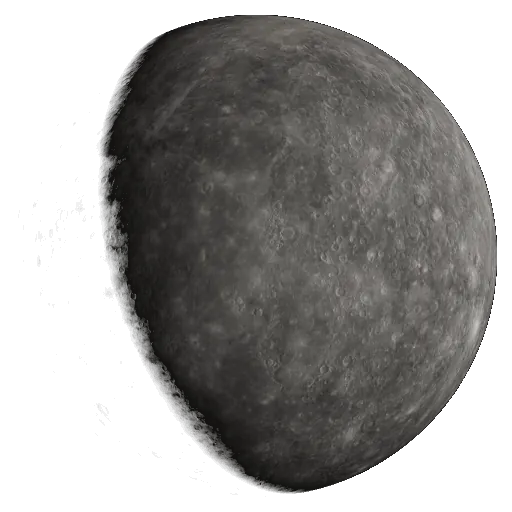
Mercury as drawn by our real-time 3D model
Still rendered from our real-time 3D model. Surface colour from NASA imagery via Solar System Scope (CC BY 4.0).

At a glance

Mercury at a glance, with sources
MeasureValueSource
Mean radius2,439.4 km (0.38 Earth)JPL Solar System Dynamics: planetary physical parameters (opens in a new tab)JPL Solar System Dynamics: planetary physical parameters (opens in a new tab)
Mass3.301 × 10²³ kg (0.055 Earth)JPL Solar System Dynamics: planetary physical parameters (opens in a new tab)JPL Solar System Dynamics: planetary physical parameters (opens in a new tab)
Mean density5.43 g/cm³JPL Solar System Dynamics: planetary physical parameters (opens in a new tab)JPL Solar System Dynamics: planetary physical parameters (opens in a new tab)
Surface gravity3.70 m/s² (0.38 g)JPL Solar System Dynamics: planetary physical parameters (opens in a new tab)JPL Solar System Dynamics: planetary physical parameters (opens in a new tab)
Escape velocity4.25 km/sJPL Solar System Dynamics: planetary physical parameters (opens in a new tab)JPL Solar System Dynamics: planetary physical parameters (opens in a new tab)
Rotation (sidereal)58.6 Earth daysJPL Solar System Dynamics: planetary physical parameters (opens in a new tab)JPL Solar System Dynamics: planetary physical parameters (opens in a new tab)
Solar day176 Earth daysNASA NSSDC Mercury Fact Sheet (opens in a new tab)NASA NSSDC Mercury Fact Sheet (opens in a new tab)
Year88.0 Earth daysJPL Solar System Dynamics: planetary physical parameters (opens in a new tab)JPL Solar System Dynamics: planetary physical parameters (opens in a new tab)
Mean distance from Sun0.387 AU (57.9 million km)NASA NSSDC Planetary Fact Sheet (opens in a new tab)NASA NSSDC Planetary Fact Sheet (opens in a new tab)
Orbit range46.0–69.8 million km (eccentricity 0.206)NASA NSSDC Planetary Fact Sheet (opens in a new tab)NASA NSSDC Planetary Fact Sheet (opens in a new tab)
Sunlight travel time3.2 minNASA NSSDC Planetary Fact Sheet (opens in a new tab)NASA NSSDC Planetary Fact Sheet (opens in a new tab)
Axial tilt0.034°NASA NSSDC Mercury Fact Sheet (opens in a new tab)NASA NSSDC Mercury Fact Sheet (opens in a new tab)
Temperature range430 °C (day) to −180 °C (night)NASA Science: Mercury facts (opens in a new tab)NASA Science: Mercury facts (opens in a new tab)
Bond albedo0.068NASA NSSDC Mercury Fact Sheet (opens in a new tab)NASA NSSDC Mercury Fact Sheet (opens in a new tab)
Magnetic fieldGlobal dipole about 1% of Earth'sNASA Science: Mercury facts (opens in a new tab)NASA Science: Mercury facts (opens in a new tab)
AtmosphereExosphere of Na, Mg, O, H, K, Ca; pressure < 5 × 10⁻¹⁵ barNASA NSSDC Mercury Fact Sheet (opens in a new tab)NASA NSSDC Mercury Fact Sheet (opens in a new tab)
Moons0NASA NSSDC Planetary Fact Sheet (opens in a new tab)NASA NSSDC Planetary Fact Sheet (opens in a new tab)
RingsNoneNASA NSSDC Planetary Fact Sheet (opens in a new tab)NASA NSSDC Planetary Fact Sheet (opens in a new tab)

Key points

With no real atmosphere to hold heat, its surface swings from 430 °C by day to −180 °C at night.

  • One solar day lasts two Mercury years
  • Caloris Basin is about 1,550 km wide
  • Water ice survives in permanently shadowed polar craters

Interior

An iron core about 2,074 km in radius, possibly partly molten, leaves only about 400 km for the rocky mantle and crust. No other planet is so metal-rich for its size, which hints that a giant impact may have stripped away much of its original rock.

Surface

Caloris Basin, about 1,550 km across, is one of the largest impact scars in the Solar System. Lobate scarps, cliffs up to about 1.6 km high and hundreds of kilometres long, formed as the cooling core shrank and the crust buckled. Inside permanently shadowed polar craters, MESSENGER confirmed deposits of water ice.

Days and nights

Mercury spins three times for every two orbits, so one sunrise-to-sunrise day lasts 176 Earth days, two full Mercury years. Near perihelion the Sun's motion across the sky briefly reverses for observers in some places.

Exploration

Mariner 10 flew past three times in 1974–75. MESSENGER orbited from 2011 to 2015 and mapped the whole planet. BepiColombo enters Mercury orbit on 21 November 2026, and its two orbiters separate in December.

What we still don't know

How a planet this small keeps a global magnetic field, why the core is so large, and how volatile elements such as sulfur and sodium survived so close to the Sun.

Missions

  1. 1973–1975

    Mariner 10

    NASACompleted

    First spacecraft to fly past Mercury, three times in 1974–75.

  2. 2004–2015

    MESSENGER

    NASACompleted

    First Mercury orbiter (2011–2015); confirmed water ice in polar craters.

    Mission page (opens in a new tab)

  3. 2018–

    BepiColombo

    ESA / JAXAEn route

    Mercury orbit insertion 21 Nov 2026; the two orbiters separate 9–10 Dec 2026 and science begins Apr 2027.

    Mission page (opens in a new tab)

First-hand · our 3D model

How we render it

Mercury is drawn as bare rock. It gets no atmosphere shell, because its exosphere is far too thin to see, so the limb stays hard and the night side falls to near-black. Its spin axis is tilted only 0.03°, so it turns almost perfectly upright, and the single key light always comes from the true direction of the Sun.

Sizes and distances in the model are not to scale, so every world can be seen up close. Colour maps are derived from NASA mission imagery via Solar System Scope (CC BY 4.0). The first frame uses light startup maps; higher-resolution maps stream in after the scene is on screen, decoded off the main thread so the page stays responsive.

Sources

  1. JPL Solar System Dynamics: planetary physical parameters (opens in a new tab)
  2. NASA NSSDC Mercury Fact Sheet (opens in a new tab)
  3. NASA NSSDC Planetary Fact Sheet (opens in a new tab)
  4. NASA Science: Mercury facts (opens in a new tab)

Last reviewed against these sources. Built from public NASA, ESA and JPL data; not affiliated with or endorsed by any agency.