
Exoplanets · Space Codex
LHS 1140 b
A dense world in its star's habitable zone.
A temperate super-Earth, possibly icy
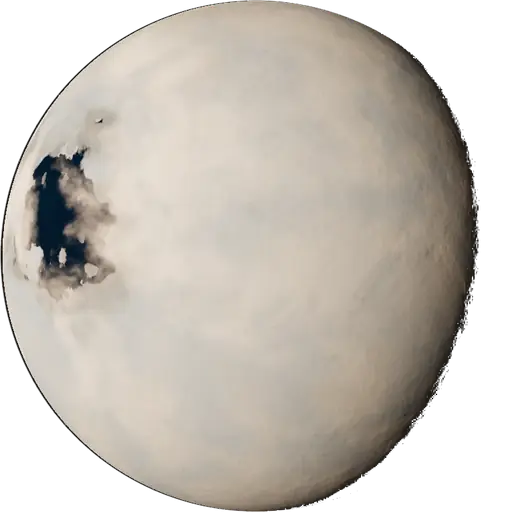
Artist's concept. No telescope has seen LHS 1140 b as more than a point of light, and most exoplanets not even that. What we know comes from how a planet dims or tugs its star. Any picture of its surface, colour or sky, anywhere, is an illustration, not an observation.
At a glance
Key points
JWST rules out a puffy hydrogen envelope; it may be a water-rich 'eyeball' planet or a rock with modest air.
- In the conservative habitable zone
- No puffy hydrogen envelope
- Possibly an ice world with a substellar ocean
How it was found
The MEarth project used small robotic telescopes to watch thousands of nearby red dwarfs for transits. In 2017 it reported a dip every 24.7 days from LHS 1140, a faint star in Cetus. The first estimate was 1.4 Earth radii and 6.6 Earth masses, a dense rock. Spitzer and later JWST measurements raised the radius to about 1.73 and lowered the mass, which is what opened the water-world possibility.
Why astronomers keep coming back
Few temperate planets are this convenient. The star is only a fifth of the Sun's width, so the planet blocks about half a percent of its light, a deep transit by rocky-planet standards. It is close, at 49 light-years, and its mass and radius are both measured, which gives a density. That combination is why JWST has spent so many hours on it.
Water world or rock?
Its mass and radius fit either a planet with 10–20% water by mass or a rocky planet with a modest atmosphere. One model makes it an 'eyeball': ice everywhere except a liquid ocean under the permanently overhead star.
What we still don't know
Whether it has an atmosphere at all. JWST is taking six more transits to search for carbon dioxide.
About this view
Artist's concept of one published model: an ice shell with a roughly 4,000 km open ocean under the fixed star. A rocky world with modest air fits the data as well.
Missions
- 2021–
Infrared observatory at Sun–Earth L2, about 1.5 million km from Earth.
First-hand · our 3D model
How we render it
LHS 1140 b uses the same ice-shell "eyeball" model as Proxima b, but its open ocean is much smaller: a patch about 4,000 km wide (11° in radius) under the 3,096 K red dwarf, which is drawn heavily spotted. A rocky planet with a modest atmosphere fits the data too.
No telescope has imaged the surface of any planet shown here, so what you see is an artist's concept: the surface is generated by a shader from noise, not drawn from a map, and its colours and features are illustrative. What is tied to measurement is the starlight and the geometry. The host star's colour is a blackbody at its catalogued temperature, and the planet is tidally locked, with a fixed day side facing the star and a permanent night side.
The host star hangs in the sky at its true apparent size seen from the planet (its radius divided by the orbit), with limb darkening that is stronger in blue and animated granulation. The planet is lit only from that star's direction and in its colour, adapted 40% towards white the way an eye adapts to a single light source. A surface glows only where it is hot enough to glow in visible light, judged from Planck's law at 550 nm. Where the concept has an atmosphere, a ray-marched haze shell adds the limb glow (10 samples at full quality, 6 at reduced, none at minimal).
Related entries
Sources
- NASA Exoplanet Archive: LHS 1140 overview (opens in a new tab)
- Cadieux et al. 2024, ApJL (arXiv) (opens in a new tab)
- Radica 2026 (arXiv) (opens in a new tab)
- Dittmann et al. 2017, Nature 544:333 (arXiv) (opens in a new tab)
- Ment et al. 2019, AJ 157:32 (arXiv) (opens in a new tab)
Last reviewed against these sources. Built from public NASA, ESA and JPL data; not affiliated with or endorsed by any agency.