
Galaxies · Space Codex
Andromeda Galaxy
A spiral galaxy 2.5 million light-years away, larger than the Milky Way and visible to the naked eye.
M31 · the nearest large spiral
At a glance
Key points
Hubble's 2025 mosaic resolved about 200 million of its stars. A future merger with our galaxy is possible but not certain.
- Visible to the naked eye from dark sites
- Hubble resolved ~200 million of its stars in 2025
- Only ~50% odds of merging with us in 10 billion years
Structure
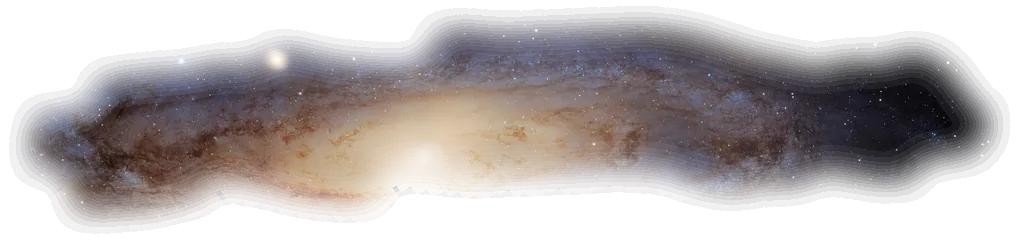
Andromeda's bright, extended bulge sits inside a disc tilted about 77° to our line of sight. Star formation concentrates in a ring about 30,000 light-years from the centre. M32, a compact companion, may be the stripped core of a galaxy Andromeda swallowed.
Collision course?
Andromeda is approaching at about 110 km/s. For years the expectation was a head-on merger in about 4.5 billion years. In 2025, Sawala and colleagues ran 100,000 simulations using Gaia and Hubble data and found roughly even odds of a merger within 10 billion years, and only about 2% for a collision within 5 billion. The Large Magellanic Cloud's pull makes a miss more likely.
What we still don't know
Its precise sideways motion, which decides whether the galaxies collide, and how many smaller galaxies it has already absorbed.
Missions
- 1990–
Hubble Space Telescope
NASA / ESAActiveUltraviolet to near-infrared imaging from low Earth orbit.
- 2013–2025
Gaia
ESACompletedMapped about two billion stars; Data Release 4 is scheduled for 2 Dec 2026.
First-hand · our 3D model
How we render it
Andromeda is the ESA/Hubble heic2501a mosaic (CC BY 4.0), shown on a camera-facing panel whose roll is locked to world up, so the galaxy never turns edge-on or spins as you orbit. The mosaic's ragged edge is feathered into transparency, and an analytic bulge-plus-disc light profile underneath lets the edge dissolve into the galaxy's own glow.
The Hubble mosaic stops just south of the nucleus. Rather than show a hard cut, the renderer completes that region from the point-symmetric opposite side of the galaxy. Foreground Milky Way stars sit in front of the image to give real parallax when you move.
Related entries
- The Milky WayOur barred spiral home galaxy
- Triangulum GalaxyM33 · the third large Local Group spiral
- Galaxies beyond oursIsland universes in an expanding cosmos
Sources
- NASA Science: Hubble Messier catalog: M31 (opens in a new tab)
- NASA: The galaxy next door (GALEX) (opens in a new tab)
- ESA: ESA/Hubble heic2501 (opens in a new tab)
- ESA: ESA/Hubble heic2508: no certainty of a Milky Way–Andromeda collision (opens in a new tab)
Image credit: Hubble 2025 mosaic: NASA, ESA, B. Williams (University of Washington), CC BY 4.0
Last reviewed against these sources. Built from public NASA, ESA and JPL data; not affiliated with or endorsed by any agency.