
Exoplanets · Space Codex
55 Cancri e
A super-Earth so close to its star that a year lasts 17.7 hours.
A lava world with a variable atmosphere
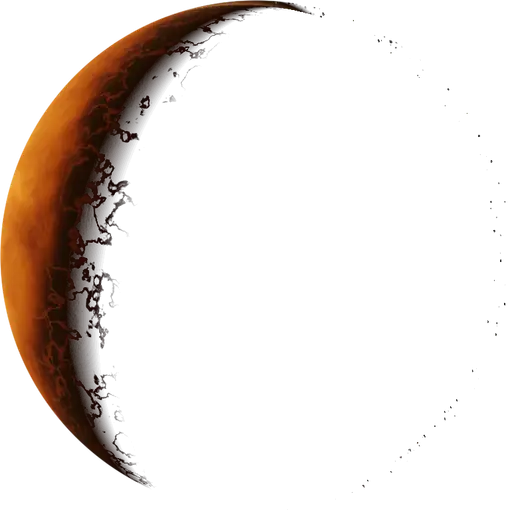
Artist's concept. No telescope has seen 55 Cancri e as more than a point of light, and most exoplanets not even that. What we know comes from how a planet dims or tugs its star. Any picture of its surface, colour or sky, anywhere, is an illustration, not an observation.
At a glance
Key points
JWST found signs of a carbon-rich atmosphere bubbling from a magma ocean, the best evidence yet for air on a rocky exoplanet.
- A year lasts 17.7 hours
- Best evidence yet for an atmosphere on a rocky exoplanet
- Its signal changes week to week
A naked-eye planetary system
55 Cancri is one of the few planet hosts you can see without optics. Five planets are known around it, from e, hugging the star at 0.015 AU, out to d, a giant of several Jupiter masses on a 13-year orbit at about 5.6 AU. For seven years e was known only from the star's wobble; in 2011 the MOST satellite and Spitzer independently caught it crossing the star's face. A faint red-dwarf companion roughly a thousand AU away has two small planets of its own, reported from SPIRou spectra in late 2025.
A burping atmosphere
At about 2,000 K the dayside is molten. JWST measured less heat than a bare rock would give off and found carbon monoxide or dioxide absorption, pointing to gas outgassed from the magma. Its brightness changes from week to week, as if the atmosphere were being replenished and lost in bursts.
Retired myths
A 2012 suggestion that it was a 'diamond planet' is outdated and not supported by later data.
What we still don't know
What drives the variability: stochastic outgassing, plumes, or something else.
About this view
Artist's concept: a molten dayside facing its star forever, with temperature falling from the substellar point, dark crust toward the night side, and a thin outgassed atmosphere whose glow varies, echoing the week-to-week changes JWST and Spitzer saw. The star fills about 30 degrees of its sky.
Missions
- 2021–
Infrared observatory at Sun–Earth L2, about 1.5 million km from Earth.
First-hand · our 3D model
How we render it
55 Cancri e is a lava world. The day-side temperature falls away from about 2,300 K at the point facing the star, and wherever it is molten the surface glows as a blackbody; elsewhere it is dark crust with faint glowing cracks. A thin orange outgassed atmosphere flickers in strength, mirroring the week-to-week changes seen in observations. Its 5,172 K star is so close that it spans about 33° of sky, so its disc is dimmed to keep it from whiting out the frame.
No telescope has imaged the surface of any planet shown here, so what you see is an artist's concept: the surface is generated by a shader from noise, not drawn from a map, and its colours and features are illustrative. What is tied to measurement is the starlight and the geometry. The host star's colour is a blackbody at its catalogued temperature, and the planet is tidally locked, with a fixed day side facing the star and a permanent night side.
The host star hangs in the sky at its true apparent size seen from the planet (its radius divided by the orbit), with limb darkening that is stronger in blue and animated granulation. The planet is lit only from that star's direction and in its colour, adapted 40% towards white the way an eye adapts to a single light source. A surface glows only where it is hot enough to glow in visible light, judged from Planck's law at 550 nm. Where the concept has an atmosphere, a ray-marched haze shell adds the limb glow (10 samples at full quality, 6 at reduced, none at minimal).
Related entries
- Exoplanets: the censusPlanets around other stars
- TRAPPIST-1Seven Earth-sized worlds · about 40.5 light-years
Sources
- Demory et al. 2011, A&A (arXiv) (opens in a new tab)
- Moutou et al. 2026, A&A 705:A190 (arXiv) (opens in a new tab)
- NASA Exoplanet Archive: 55 Cnc overview (opens in a new tab)
- Hu et al. 2024, Nature 630:609 (arXiv) (opens in a new tab)
- Patel et al. 2024 (arXiv) (opens in a new tab)
- Winn et al. 2011, ApJL (arXiv) (opens in a new tab)
- IAU: NameExoWorlds results (iau1514) (opens in a new tab)
Last reviewed against these sources. Built from public NASA, ESA and JPL data; not affiliated with or endorsed by any agency.